Table of Contents
The adoption of artificial intelligence (AI) in the business world is not a passing trend — it is a transformative shift that is redefining how Spanish companies operate and compete. The introduction of AI technologies has enabled businesses to optimize processes, improve decision-making, and deliver personalized customer experiences, positioning many Spanish firms at the forefront of digital innovation in Europe.
To fully understand this transformation, it is essential to contextualize the growing interest in and necessity of AI within Spain’s current economic landscape. This perspective helps explain why companies are increasingly investing in emerging technologies as a strategic priority rather than an optional upgrade.
AI Adoption in Spanish Businesses: An Overview
Artificial intelligence is reshaping the global business landscape, and Spain is no exception. At the core of this transformation lies AI’s ability to streamline operations, enhance decision-making, and deliver tailored customer experiences. In Spain, AI adoption is becoming inevitable, driven by the need to remain competitive in an increasingly digital marketplace.
From banking to tourism, AI integration is enabling Spanish companies to stay ahead. Understanding the motivations behind this shift — and examining real-world success stories — reveals how deeply AI is influencing strategic growth.
Why AI Is Crucial for Spanish Companies
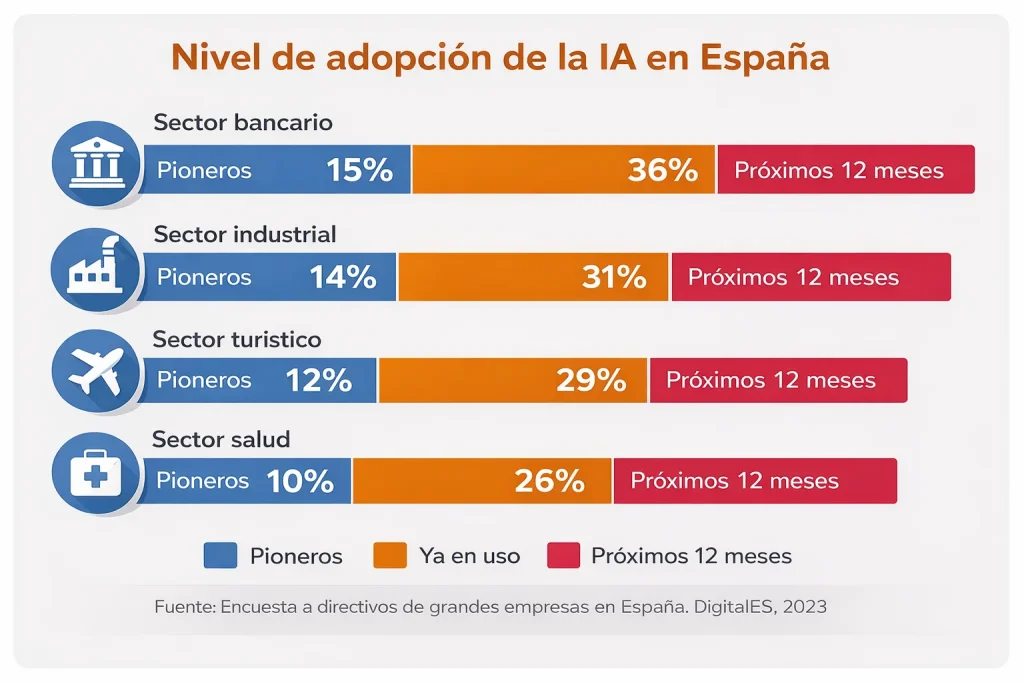
Operational efficiency and digital transformation are no longer optional. According to DigitalES, nearly 50% of large companies in Spain have already adopted AI. The direction is clear: investing in artificial intelligence is not a luxury — it is a necessity.
- By leveraging AI technologies, companies can:
- Analyze and predict consumer behavior patterns
- Optimize inventory management
- Improve marketing effectiveness
- Deliver highly personalized customer experiences
- Reduce operational costs and increase efficiency
- Make data-driven decisions with greater precision
AI has become a strategic tool for boosting productivity and strengthening competitive advantage.
The Evolution of AI in the Business Environment
From basic algorithms to advanced machine learning solutions, AI has evolved at remarkable speed. Spanish companies are rapidly transitioning toward environments where intelligent automation is becoming the standard.
McKinsey reports that companies integrating AI have seen productivity increases of up to 20%. This figure reflects the tangible impact of digital transformation across industries.
In the banking sector, institutions such as CaixaBank are leveraging AI to deliver faster and more efficient customer service. Meanwhile, in tourism — a key pillar of Spain’s economy — AI is being used to personalize travel experiences, enhance booking systems, and improve customer satisfaction.
Digital Innovation and Business Transformation
How AI Drives Digital Transformation
Digital transformation in Spanish companies is being accelerated by AI implementation, enabling greater agility and adaptability in constantly evolving markets. Rapid AI integration into operational processes has become essential for building sustainable competitive advantages.
Advanced AI tools allow companies to optimize internal resources, improve operational efficiency, and reduce costs. In the healthcare sector, for example, AI is being used to forecast patient flows, improve planning, and reduce strain on facilities.
AI adoption is more than a technological upgrade — it acts as a cultural catalyst, reshaping how organizations interact with customers and employees alike.
Challenges of Implementing AI in Companies
Despite its benefits, implementing AI presents significant challenges. Resistance to change and adaptation to new technologies remain critical barriers for many organizations.
Shortage of Internal Technical Skills
One of the primary obstacles is the lack of in-house technical expertise required to effectively implement and manage AI systems. Spanish companies must invest in training and professional development to equip their workforce with the necessary skills.
- Employees need to understand how AI enhances their roles rather than replaces them.
- Continuous training is essential to stay current with rapid AI advancements.
- Cross-functional collaboration fosters a holistic approach to AI-driven innovation.
Without internal capability development, AI initiatives risk underperformance or failure.
Personalized Experiences as a Competitive Advantage
AI is not only optimizing processes — it is enabling companies to deliver deeply personalized customer experiences, which have become a key competitive differentiator.
Spanish businesses are using advanced algorithms to collect and analyze customer data, gaining detailed insights into preferences and behavior. This knowledge allows them to push the boundaries of personalization, strengthen customer relationships, and build long-term loyalty.
Conclusion
The adoption of artificial intelligence in Spanish companies represents a structural transformation. AI is not merely improving operational efficiency — it is redefining how businesses interact with customers, manage resources, and compete in the marketplace.
The path forward requires overcoming implementation challenges while maximizing the strategic opportunities AI provides. Companies that successfully integrate AI into their operations will secure sustainable competitiveness in the years ahead.