Table of Contents
Advertising in 2025 isn’t just about selling; it’s about resonating with people in a saturated, hyper-personalized digital landscape. Consumers have more control over what they see, algorithms adapt in real time, and competition for attention is fiercer than ever. Copywriting, therefore, isn’t simply a skill — it’s an adaptive craft that blends psychology, cultural insight, and data-driven creativity.
Below, you’ll find 8 highly effective ad copywriting tips to help you not only capture attention but also drive meaningful action in today’s evolving marketplace.
1. Start with deep audience intelligence, not assumptions
The biggest mistake many brands still make is beginning with the message they want to deliver instead of the mindset of the person they want to reach.
In 2025, “knowing your audience” means going far beyond demographic profiles. It requires understanding their micro-behaviors, emotional triggers, and even the cultural or technological environments they inhabit daily.
Instead of creating generic “buyer personas” that read like stock photo captions, invest in real behavioral mapping:
- Analyze search intent behind the keywords your audience uses.
- Study their language patterns in comments, reviews, and forums.
- Observe what they save, share, or skip on social media platforms.
- Pay attention to the emotional context around their online activity.
When you write with this depth of understanding, your copy feels less like a pitch and more like an inside conversation — and that’s what earns clicks and conversions today.
Go deeper: 7 affordable difgital marketing for startups
2. Lean into hyper-specificity
Broad, sweeping claims may have worked in the past, but audiences today have a radar for vague marketing language. They want precision. They want details they can visualize, trust, and repeat.
Instead of: “Our coffee will make your mornings better.”
Try: “Brew a cup in 45 seconds and keep it hot for 4 hours, without a single paper pod.”
Specificity works because it grounds the promise in reality. It shows you’ve thought about the details that matter to the customer. It also makes your ad more quotable and more memorable.
A useful exercise: go through your copy and highlight any adjective or benefit. Then, ask yourself, “How exactly?” If you can answer with a concrete, measurable fact, your ad will stand out in a world of vague noise.
3. Write for scanning, not reading
Ad copy is rarely read word-for-word. In most cases, users scan until they find a word or phrase that earns their attention. The structure of your copy can determine whether they pause or pass.
In 2025, this means:
- Breaking down sentences so the first few words pack the core idea.
- Using micro-headlines and subheadings even in short ads.
- Placing benefits in bullet points when appropriate.
- Creating visual rhythm: short sentence, longer sentence, impact sentence.
Digital platforms from Instagram to LinkedIn now experiment with “truncated preview” formats, only showing the first 2–3 lines before cutting off. If those first lines don’t spark curiosity or deliver a clear benefit, you’ve lost the click before you’ve even started.
4. Merge emotional resonance with data-backed claims
The best ads in 2025 are neither purely sentimental nor purely analytical, they blend both. Emotion drives attention; data builds trust. For example: “90% of people who switched to our sleep app reported falling asleep faster, finally waking up without the 3 a.m. phone scroll.” This sentence opens with a credible statistic, then wraps it in an emotional payoff: the relief of uninterrupted rest. The copy is measurable yet deeply human. When merging these two forces:
- Lead with the emotional trigger.
- Immediately support it with a statistic, proof point, or tangible feature.
- Avoid sterile data dumps; frame numbers within human outcomes.
Go deeper: What to look from content services
5. Adapt tone for micro-contexts
In 2025, “one ad fits all” is a relic. Platforms and audience mindsets shift dramatically depending on where your message appears.
For example:
- LinkedIn Ads: Professional, forward-looking, anchored in ROI and industry relevance.
- TikTok Ads: Conversational, trend-aware, often leveraging humor or cultural moments.
- Email subject lines: Crisp, curiosity-driven, personalized with name or interest.
The key is contextual fluency, speaking the audience’s language without losing your brand’s voice. This often means developing tone guidelines that include:
- Platform-specific vocabulary.
- Sentence length recommendations.
- Level of formality by audience segment.
You don’t have to reinvent your brand personality; you simply let it adapt like a chameleon to different lighting.
6. Master the art of the first five words
Every second of hesitation is a chance for the user to scroll past. In most digital ad formats, the first five words carry disproportionate weight. Why? Because:
- They appear in previews before the “…see more” fold.
- They often dictate whether someone stops scrolling.
- They frame the mental category for the rest of your message.
Weak start: “We’re excited to announce our…” Strong start: “Stop wasting 2 hours every morning.” The latter instantly hooks attention with a relatable frustration. Your opening should be:
- Urgent, without being click-bait.
- Relevant to the audience’s current need or frustration.
- Structured so the meaning is clear even if the rest isn’t read.
7. Use layered calls-to-action
In 2025, the “Buy now” button isn’t enough. The call-to-action (CTA) has evolved into a layered experience that guides the reader from interest to action without friction.
Consider:
- Primary CTA: The direct action (“Start your free trial”).
- Secondary micro-CTA: A low-commitment step (“Watch how it works”).
- Reassurance tag: A friction-reducing phrase (“No credit card required”).
This layered approach works because it accounts for different readiness levels. Someone might not be ready to buy immediately, but they might be willing to watch a 20-second demo. That secondary engagement builds familiarity and trust.
Also, test CTA placement. In mobile-first design, a mid-copy CTA can outperform a footer-only approach, especially when paired with a benefit-driven headline.
8. Test like a scientist, write like a human
Even the most seasoned copywriters can’t predict with 100% certainty what will resonate. In 2025, testing is non-negotiable but it must be methodical.
This means:
- Isolating one variable at a time (headline, CTA, offer framing).
- Using statistically significant sample sizes before drawing conclusions.
- Documenting learnings for future campaigns.
However, remember: testing is only as good as the humanity behind it. Ads that win aren’t just “optimized for clicks” — they’re optimized for connection. Algorithms reward engagement metrics, but people reward emotional truth, humor, trustworthiness, and relevance.
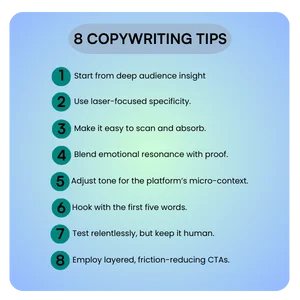
8 effective ad copywriting tips in 2025
- Know your audience deeply
- Be ultra-specific
- Make it easy to scan
- Blend emotion with proof
- Adapt tone to context
- Hook with the first 5 words
- Use layered CTAs
- Test and optimize always
FAQs
Ad copy is the written text used in advertisements with the specific goal of persuading the audience to take a desired action, such as clicking a link, signing up for a service, or making a purchase.
- Know your audience deeply
- Be ultra-specific
- Make it easy to scan
- Blend emotion with proof
- Adapt tone to context
- Hook with the first 5 words
- Use layered CTAs
- Test and optimize always
- Clear
- Concise
- Credible
- Compelling